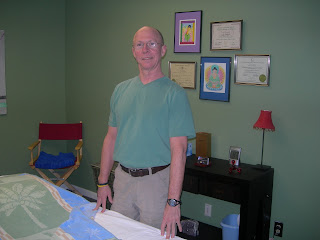
That is a powerful quote from The Wharton Stretch Book. You can look at fitness from living everyday life to doing an Ironman Triathlon. However you look at it, flexibility is the key to movement. Movement is the most basic part of doing what we do whether it's working, exercising, eating and playing (this can be considered exercising too. I am one that cannot exercise and I'm fortunate to be able to go out and play daily and people think that I'm exercising).
I just can't quit talking about stretching and how important it is in our lives. Here's an example of what I see in my practice. I see clients daily with tight pectoralis minor, anterior deltoid and biceps. You'd think they are some kind of athlete wouldn't you. No, they are people that spend a long time daily on the computer and hairstylists. They are working with there shoulders forward and the arms lifted thus shortening those muscles the entire time. This is BAD. It can also lead to the dreaded Carpal Tunnel Syndrome or just the symptoms. The brachial plexus is a bundle of nerves that goes into the arm through pec minor. If pec minor is tight, it can squeeze those nerves causing numbness and tingling down in the hands. The solution is simple. Stretch those muscles out daily after doing that repetitive motion.
As athletes, we are constanly looking for a competitive advantage. Training more is usually always the first choice for us to get that advantage. When we go out and train more, we are shortening the muscles. It is imperative that we take time to stretch those muscles out. I hear over and over again "I just don't have time to stretch". I tell 'em you make time to do the things that are important to you. Stretching is one of those IMPORTANT things.
I have a client that is really busy. She is an athlete trying to balance workouts with work. She had gotten really tight and little injuries kept popping up. I told her that if she had 45 minutes to run, run 35 minutes and stretch ten. She has started that and she is getting amazingly loose. She didn't think it was possible.
If you want to run fast or bike fast, you have to loosen up those hips so you can create a faster turnover. Stretching the gluteal muscles and hip flexors are really important. When those things get out of balance, you'll see one hip higher than the other, the pelvis tilting one way or another and other abnormalities. When these things exist, you can still do what you do but injury is lurking in the darkness. You've gotta stretch.
So did you think that I was going to just leave you with no solutions. Here's the deal. If you have healthy muscle tissue, yoga is a great way to lengthen your muscles. If you have muscles that are severely tightened or injured, use Active Isolated Stretching for the best results. Look over to the sidebar on the right and you'll see links for The Wharton Stretch Book and Active Isolated Stretching with Aaron Mattes. These guys work with athletes and everyday people. They can help you get loose too.
Happy stretching to you.
Saturday, February 17, 2007

Saturday, February 10, 2007
Wear Out or Rust Out
Our bodies are absolutely incredible. They rival things like computers and jet planes yet we take them for granted. We know or expect that when we wake up everyday that it going to be there for us. Most of the time it is ready and willing to do whatever we want it to do. It is designed to move. Yes, movement is the only way to keep the body healthy. It is an absolute fact that we will rust out faster than we will wear out.
When we wake up feeling stiff and groggy, it is a signal to get out and do something. For some reason, our brain says sit down on the couch. That is a bad idea. We need to get moving. Movement gets the blood flowing. It gets the synovial fluid (lubricant for the joints) flowing. It activates the lymph system. These are the things that fight to keep our bodies healthy. We must not let the lure of the couch win. This is most important as we get older. We just can't let up. Get out and exercise. It is the absolute best way to enjoy those golden years.
Let's make some comparisons. We will begin with the benefits of exercise:
1. Weight loss
2. Healthier skin
3. Reduces blood sugar
4. Reduces blood pressure
5. Increases organ function
6. Strengthens the heart
7. Strengthens muscles
8. Improves self image
I am sure there are more but they won't come to me now. Feel free to add in the comments section.
Now let's look at the benefits of sitting on the couch. Hmmm, there aren't any. Let's look at what can happen.
1. Get fat
2. Blood pressure rises
3. Blood sugar rises
4. Joints stiffen
5. Decreased organ function
6. Arteries clog
7. Loss of muscle tissue
8. Self image declines
Get the picture? Now I'm not saying that if you exercise that none of the bad things can happen to you. I am saying that it greatly reduces the chances of premature aging and increases the chances that you will enjoy life to it's fullest.
Don't sell the furniture. Use it as a reward for a life well lived.
Summary: Stretch, exercise, eat right. Enjoy life. Wow, that sounds pretty simple huh?
We make a choice everyday. We are either living or dying. Think about it.
When we wake up feeling stiff and groggy, it is a signal to get out and do something. For some reason, our brain says sit down on the couch. That is a bad idea. We need to get moving. Movement gets the blood flowing. It gets the synovial fluid (lubricant for the joints) flowing. It activates the lymph system. These are the things that fight to keep our bodies healthy. We must not let the lure of the couch win. This is most important as we get older. We just can't let up. Get out and exercise. It is the absolute best way to enjoy those golden years.
Let's make some comparisons. We will begin with the benefits of exercise:
1. Weight loss
2. Healthier skin
3. Reduces blood sugar
4. Reduces blood pressure
5. Increases organ function
6. Strengthens the heart
7. Strengthens muscles
8. Improves self image
I am sure there are more but they won't come to me now. Feel free to add in the comments section.
Now let's look at the benefits of sitting on the couch. Hmmm, there aren't any. Let's look at what can happen.
1. Get fat
2. Blood pressure rises
3. Blood sugar rises
4. Joints stiffen
5. Decreased organ function
6. Arteries clog
7. Loss of muscle tissue
8. Self image declines
Get the picture? Now I'm not saying that if you exercise that none of the bad things can happen to you. I am saying that it greatly reduces the chances of premature aging and increases the chances that you will enjoy life to it's fullest.
Don't sell the furniture. Use it as a reward for a life well lived.
Summary: Stretch, exercise, eat right. Enjoy life. Wow, that sounds pretty simple huh?
We make a choice everyday. We are either living or dying. Think about it.
Saturday, January 20, 2007
Piriformis syndrome
IT'S A PAIN IN THE BUTT! I know as well as anyone. I've got it. I think it's contagious. I've worked on so many people with it that I caught it. I had mine worked on yesterday and hardly slept at all last night. However, I think that I'm better today. I'm just sleepy.
What is a piriformis? It is a small pear shaped muscle that can wreak more havoc than a sunami. Well, that's what it feels like to the person with one that's inflamed. It is a lateral rotator of the thigh that we engage with every step or pedal stroke for you bikers. It get's a lot of work. Some of us will go through life and never be troubled by this little monster. Those of us that are "very active" are more prone to the symptoms and they vary in degree. Some just have the pain in the butt. Others may experience the pain in the butt, tightness in the hamstring, or pain in the hamstring all the way down and around to the shin (tibialis anterior) and into the foot or all of the above. If you're wondering how one little muscle can wreak all of this havoc? Here's the deal. The sciatic nerve (ever heard of this devil?) innervates under the piriformis so when piriformis gets inflamed and tight it squeezes the sciatic nerve causing all of this pain. Trust me, there is no pain like nerve pain. When really bad, it can involve all the muscles of the gluteal region and the SI joint.
So what do you do if this pain in the butt appears? See someone right away. If it persists long enough it becomes a syndrome which means that it is entrenched and muscle memory has changed. Yes, the body thinks that this pain is normal and it will take longer to get rid of it.
I saw client the other night and he was in terrible shape. He had been suffering for 3 months and his wife suggested that he see me. I have never felt more empathy for anyone as I did him. He had his shoulders hiked up, one hip hiked up, and walked like he absolutely dreaded the next step. His entire body was in "full armoring"(when you've hurt so long that everything locks down). I spent an hour just trying to break through and had some success. After the session, I spent another fifteen or so minutes teaching him some stretches and exercises to get him on his way to recovery. He's rescheduled and will come in on Tues for another session. I saw his wife yesterday and I was so happy to hear that he feels better already. I was concerned that he would probably get worse before getting better.
I've discovered a really easy and excellent stretch for this malady. Stand in a doorway, reach out with both arms and grasp the sides of the doorway, cross the leg of the affected piriformis over the other leg and sit down and lean back. Hold two seconds and repeat 10 to 15 times. You might as well do them both so you don't start listing to one side.
Avoid all pains in the a#! and stretch.
What is a piriformis? It is a small pear shaped muscle that can wreak more havoc than a sunami. Well, that's what it feels like to the person with one that's inflamed. It is a lateral rotator of the thigh that we engage with every step or pedal stroke for you bikers. It get's a lot of work. Some of us will go through life and never be troubled by this little monster. Those of us that are "very active" are more prone to the symptoms and they vary in degree. Some just have the pain in the butt. Others may experience the pain in the butt, tightness in the hamstring, or pain in the hamstring all the way down and around to the shin (tibialis anterior) and into the foot or all of the above. If you're wondering how one little muscle can wreak all of this havoc? Here's the deal. The sciatic nerve (ever heard of this devil?) innervates under the piriformis so when piriformis gets inflamed and tight it squeezes the sciatic nerve causing all of this pain. Trust me, there is no pain like nerve pain. When really bad, it can involve all the muscles of the gluteal region and the SI joint.
So what do you do if this pain in the butt appears? See someone right away. If it persists long enough it becomes a syndrome which means that it is entrenched and muscle memory has changed. Yes, the body thinks that this pain is normal and it will take longer to get rid of it.
I saw client the other night and he was in terrible shape. He had been suffering for 3 months and his wife suggested that he see me. I have never felt more empathy for anyone as I did him. He had his shoulders hiked up, one hip hiked up, and walked like he absolutely dreaded the next step. His entire body was in "full armoring"(when you've hurt so long that everything locks down). I spent an hour just trying to break through and had some success. After the session, I spent another fifteen or so minutes teaching him some stretches and exercises to get him on his way to recovery. He's rescheduled and will come in on Tues for another session. I saw his wife yesterday and I was so happy to hear that he feels better already. I was concerned that he would probably get worse before getting better.
I've discovered a really easy and excellent stretch for this malady. Stand in a doorway, reach out with both arms and grasp the sides of the doorway, cross the leg of the affected piriformis over the other leg and sit down and lean back. Hold two seconds and repeat 10 to 15 times. You might as well do them both so you don't start listing to one side.
Avoid all pains in the a#! and stretch.
Wednesday, January 17, 2007
Knee pain solution

Patella tracking dysfunction, chrondomalacia, ow! the sound of those ailments makes me hurt. Those are a couple of the most common knee problems that athletes experience. The symptoms usually manifest themselves behind the knee cap. They are condsidered in many cases as overuse injuries. However, most knee pain is caused from one tight muscle. It is rectus femoris. This is the muscle that is right in the middle of the powerful quadricep group. The problem begins with rectus femoris originating at the anterior superior illiac spine and the others at the anterior inferior illiac spine. So what happens when we do the traditional quad stretch, rectus femoris, because it is longer doesn't get any stretch.
One of the telltale obvious signs of a tight rectus femoris is popping in the knee. This popping is usually painless but still an alarm for danger lurking. The solution for this problem is stretching. How do you stretch this muscle if the traditional way doesn't work? Go non traditional.
Here is how to do it.This stretch looks and feels kind of weird at first but it is very effective. It also gives psoas major and tensor fascialata, both hip flexors, a stretch too. Even if you have just one knee bothering you, stretch them both. Here's what you do. Lie on the floor on your side. It doesn't matter which side since you are going to stretch both. OK assume the fetal position. Take the down arm and hold the down (closest to the floor) knee, grab the ankle of the other leg with the up arm. If you are too tight to grab the ankle, use a belt or piece of rope for extension. Keeping the leg parallel to the floor, pull back til you feel a good stretch. Hold for 2 seconds and repeat 15 times. If the leg isn't parallel, you won't stretch rectus femoris. Repeat this exercise daily. Be careful when you first begin doing this stretch. Don't overstretch it. It will just delay getting to the solution.
Be well and stretch something.
Tuesday, January 16, 2007
Muscle Memory What's That?
When we are born our body starts remembering what muscle tissue is supposed to feel like. As we go through life and get bumps and bruises along the way our muscle memory changes. Hopefully, upon healing our muscle memory returns to normal.
Let me give an example. I'll be working with a client and discover a knot in the calf muscle. I'll ask if there is any tenderness. The response is no. What has happened is the muscle has accepted that knot as normal and turned off the pain sensors. Now because the muscle has accepted this as normal it will take longer to change. When work begins to make a change and return the muscle to the "real normal", the muscle might start feeling that tenderness again because an outside source is trying to bring about change.
The best solution is to address injury as soon as possible after it occurs. Begin the healing process and get the muscle smooth and healthy to avoid "bad" muscle memory. When changing muscle memory back to normal you have to stay after it. If you don't, the body will hold on to the "bad memory" because it will accept it as normal. Staying after it means massage and stretching. It will eventually return to the "real normal". Keep your muscles lean and healthy by stretching everyday and staying hydrated. Water is what we use to lubricate our muscles and they love lots of it.
Stay well and hydrate.
Let me give an example. I'll be working with a client and discover a knot in the calf muscle. I'll ask if there is any tenderness. The response is no. What has happened is the muscle has accepted that knot as normal and turned off the pain sensors. Now because the muscle has accepted this as normal it will take longer to change. When work begins to make a change and return the muscle to the "real normal", the muscle might start feeling that tenderness again because an outside source is trying to bring about change.
The best solution is to address injury as soon as possible after it occurs. Begin the healing process and get the muscle smooth and healthy to avoid "bad" muscle memory. When changing muscle memory back to normal you have to stay after it. If you don't, the body will hold on to the "bad memory" because it will accept it as normal. Staying after it means massage and stretching. It will eventually return to the "real normal". Keep your muscles lean and healthy by stretching everyday and staying hydrated. Water is what we use to lubricate our muscles and they love lots of it.
Stay well and hydrate.
Friday, January 12, 2007
Massage and stretching
As I have mentioned in previous posts, I work with a lot of athletes. I find that incorporating stretching with my clients during massage is very beneficial to them. Warming the muscles up and then stretching them really helps to facilitate maximum release. I use bath sheets (really big towels) and weight of the bath sheets allows the client to feel that all of the important areas are covered and that their safety is paramount. I do have one client that insists on stretching at the conclusion of the massage and she is fully dressed and that's OK. That's the neat thing about massage, the client gets to call all of the shots.
The amazing thing is that my "non athletes" love the stretching too. I have many 50 and 60 year old men and women that just rave about the stretching. I'm thinking that one day someone is going to tell me how great my ephleurage and petrissage (massage strokes) is but NO, they always say " I love that stretching. I've never experienced that in a massage".
If I don't stop blogging about stretching, that may become my new nickname. It is important though and if you haven't experienced it with massage, ask your therapist if they can do it or better yet, call me.
Peace and good health.
The amazing thing is that my "non athletes" love the stretching too. I have many 50 and 60 year old men and women that just rave about the stretching. I'm thinking that one day someone is going to tell me how great my ephleurage and petrissage (massage strokes) is but NO, they always say " I love that stretching. I've never experienced that in a massage".
If I don't stop blogging about stretching, that may become my new nickname. It is important though and if you haven't experienced it with massage, ask your therapist if they can do it or better yet, call me.
Peace and good health.
Saturday, January 6, 2007
Dealing with Inflammation
What do I do about inflammation? That's a frequent question for me. I always recommend the "Pittsburgh ice pack" It's really easy to make and is reusable time and time again. It is the coldest of cold packs so I suggest you put a couple of damp paper towels over the area that you are going to ice and put the ice pack on the paper towels. It will help prevent frost bite. This ice pack delivers instant cold so don't use it for more than 20 minutes at a time. It may be repeated every 3 hours.
The recipe is:
16 oz. of rubbing alcohol
32 oz of water
2 cup of sugar
Mix this combination in a sauce pan and heat it until the sugar melts. Let it cool and pour into a gallon sized zip lock bag (I recommend double bagging). Place it in the freezer and it will be ready too use in 24 to 36 hours. Put it back in the freezer after each use and it will provide you with years of use.
When dealing with injury that includes inflammation, use the RICE theory. That is:
Rest
Ice
Compression
Elevation
What about heat? Don't use heat where you have inflammation. It is fine to heat sore, aching muscles to warm them up before exercising or working.
Stay well and use caution when icing. Remember you can get frostbite.
Caution: You may be tempted to mix this concoction with Coke when you are better. Don't do it. It may cause blurred vision.
The recipe is:
16 oz. of rubbing alcohol
32 oz of water
2 cup of sugar
Mix this combination in a sauce pan and heat it until the sugar melts. Let it cool and pour into a gallon sized zip lock bag (I recommend double bagging). Place it in the freezer and it will be ready too use in 24 to 36 hours. Put it back in the freezer after each use and it will provide you with years of use.
When dealing with injury that includes inflammation, use the RICE theory. That is:
Rest
Ice
Compression
Elevation
What about heat? Don't use heat where you have inflammation. It is fine to heat sore, aching muscles to warm them up before exercising or working.
Stay well and use caution when icing. Remember you can get frostbite.
Caution: You may be tempted to mix this concoction with Coke when you are better. Don't do it. It may cause blurred vision.
Subscribe to:
Posts (Atom)